
You wrote a rigorous breakdown of a private-lending dispute. Zero search traffic. The account next door wrote "what to do when a friend won't pay you back" and hit 10K likes in three days. Same legal question — the difference is one word in the title. Your audience never searches for the term you used.
If you run a content account in a specialized niche — law, finance, medicine, education — you've probably hit this wall: your content is far more authoritative than your peers', yet your search traffic stays flat. The problem usually isn't content quality. It's that you and your audience aren't speaking the same language. The first step to getting search traffic for expert content is admitting one thing: the term in your head almost certainly isn't in your audience's vocabulary.
What people type into the search bar is their current situation, not your knowledge structure. When someone hits a problem, there's no technical term in their head — only plain language.
That gap is brutal in expert niches. Look at a few real contrasts:
| Industry | What the expert writes (jargon) | What users actually search (plain language) |
|---|---|---|
| Law | private lending dispute | friend won't pay me back, what do I do |
| Medical | sleep disorder / insomnia | can't fall asleep at 3am |
| Finance/Tax | small-business tax planning | how much tax does a sole proprietor pay |
| Education | preschool cognitive development | is it normal my 3-year-old barely talks |
The left column is the language you used in school, in practice, in your papers. The right column is what an ordinary person types in at 3 AM unable to sleep, panicking over a debt, filing taxes for their first shop. Both columns point to the same need — but search traffic only flows to the right.
The more expert you are, the more you default to assuming your audience asks questions the expert way. That's exactly why expert content goes undiscovered: the content is fine, but the word in the title is one nobody searches.
You're Not Short on Knowledge — You're Short on Your Audience's Words
Expert creators have a built-in blind spot: knowing too much makes it hard to imagine how someone who knows nothing would phrase the question.
A lawyer with ten years of practice reaches for "creditor's rights" and "statute of limitations." But the person who comes to them asks "can I still get my two grand back?" or "he keeps stalling — can I sue him?" The lawyer knows the answer; they just don't know which words the user types to search for that answer.
You assume people search for "parent-child communication techniques." What they actually search is "my kid cries every time I say something — what do I do?" You can't guess your way to these. You have to look at the platform's real search suggestions.
The crudest and most effective method: go to the Xiaohongshu search bar, type your niche's core term, then add each letter a, b, c all the way to z behind it, reading the autocomplete every time. Every suggestion the platform serves up only appears because real people actually searched it. Expand "insomnia" and you'll see "insomnia and vivid dreams," "insomnia headache what to do," "insomnia means something's wrong with which organ."
We break down the full A-Z expansion method in How to Find Precise Search Traffic on Xiaohongshu, so I won't repeat it here. The extra thing to watch for in expert niches: deliberately hunt for the words that "don't sound like something a professional would say." The more it sounds like a layperson, the more likely it's a high-traffic entry point.
Turn One Expert Term into Hundreds of Real Questions People Search
Running a-to-z by hand means roughly thirty or forty keystrokes per term and scrolling through that many suggestion lists. Legal and finance niches have an enormous number of terms — "contract," "divorce," "workplace injury" alone could eat your whole afternoon, and Xiaohongshu has one set of suggestions while Douyin (TikTok China) has another.
We built this action into MediaClaw's Keyword Intelligence feature: enter one seed term, and the extension automatically types a-z (all 26 letters) into the search bar, batch-captures the platform's autocomplete suggestions, deduplicates them, and hands you a complete keyword list. From 1 term to 200+, completely free, unlimited, ready the moment the extension is installed — no account required.
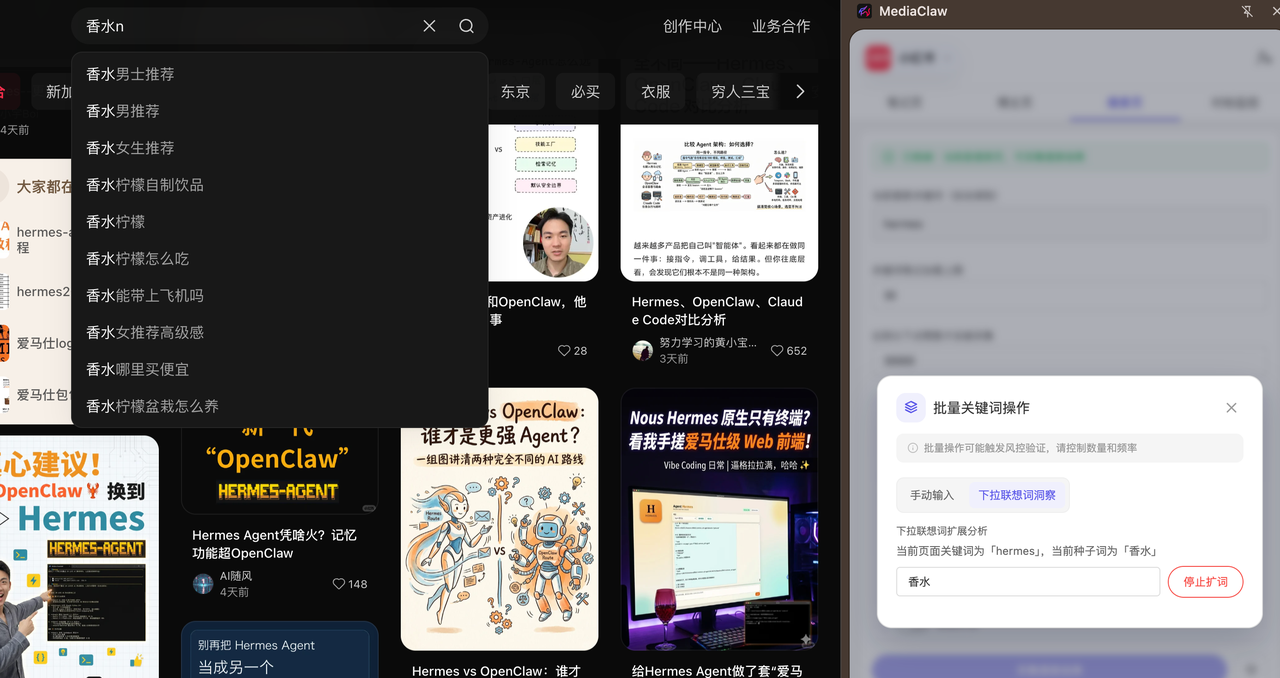
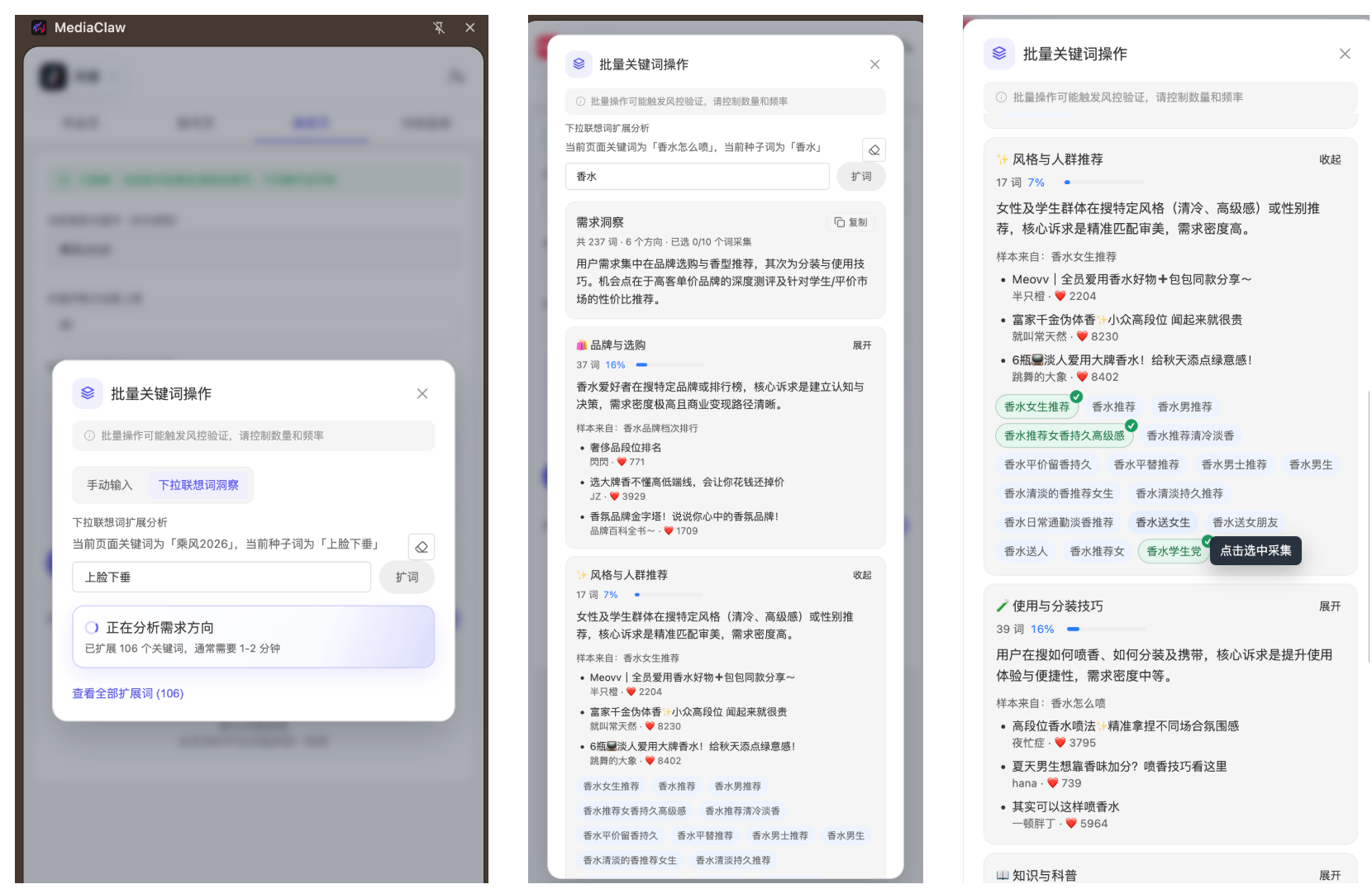
With those 200-odd words in hand, you can already tell at a glance which are laypeople's wording and which are jargon. But there are too many to read through comfortably. This is where AI Insights groups the whole pile into 6 to 10 demand directions, gives each a short brief, and picks out 15–20 high-value words to prioritize.
For expert creators, the value of this step is reverse-engineering your titles. It clusters "what users are actually confused about" by direction — you can clearly see that people searching "workplace injury" split into those asking how it's classified, those asking how much the payout is, and those asking what to do when the company denies it. Each direction is a type of patient or client, and the most-searched plain-language word inside that direction is the word your next post's title should use.
The whole chain is a closed loop: enter a seed term → expand into 200+ plain-language words → AI clusters them into demand directions → one click triggers search-result collection for the chosen words, landing in Feishu (Lark) or CSV. Getting search traffic for expert content goes from "guessing how users search" to "letting the data decide your title."
Get One Word Right in the Title and Search Traffic Finally Comes In
Finding the words is only half the journey. What actually decides your traffic is which word you put in the title.
The principle is simple: the core word in your title must be the plain-language word users actually search, not the one that's more technically accurate to you. A post on inheriting property: change the title from "statutory order of succession" to "the cheapest way to transfer a parent's home to their kids" — same content, completely different search entry point.
In practice, when picking words, prioritize the high-value words AI Insights recommends, then apply one test: does this read like something a layperson would blurt out? If yes, you've got it. The expert part belongs in the body — users click in because of the plain-language word, and follow you because your content is genuinely authoritative.
Entry points are entry points, depth is depth. Don't mix the two.
For the specific layout of core word in the title and supporting words across the body, see The Xiaohongshu Keyword Placement Playbook. And if you want to systematically build up a batch of topics — turning your expanded words into a long-term topic library — How to Build a Xiaohongshu Topic Library lays out a ready-made process.
Wrap-Up
Getting search traffic for expert content doesn't come from writing deeper — it comes from translating jargon into the plain language users type into the search bar. Use free search-suggestion expansion to break one big term into hundreds of real questions, then use AI Insights to reverse-engineer which word goes in your title. Only then does your expert content become findable. Install MediaClaw now, enter one term from your niche, and see exactly how your audience searches in 2 minutes.
FAQ
Why does my expert content get no search traffic on Xiaohongshu?
Most likely your title uses a technical term while users search in plain language. You write "private lending dispute"; they search "what to do when someone won't pay you back." No matter how authoritative the content is, if the title doesn't contain the word users type, search won't match it. Use search-suggestion expansion to see what users actually search, then go back and fix your title.
How do I turn jargon into keywords ordinary people search?
Use the a-z expansion method in the search bar, or run it all at once with a tool, and look at the platform's real autocomplete — every one of those appeared because someone searched it. Put your jargon side by side with the expanded plain-language words, pick the one that sounds the most like a layperson and has the highest search volume, and put it in your title.
For expert niches like law and medicine, what word should the title use to get found?
Use the sentence a patient or client would blurt out as the title's main word — not the diagnosis name, charge name, or statute name. For medical, write "can't sleep at night" instead of "sleep disorder"; for law, write "the other party won't refund my deposit, what do I do" instead of "breach of contract." Save the expertise for the body; the title's only job is to hit the search.
Can I find words this way for expert content on Douyin too?
Yes. Douyin's Keyword Intelligence feature offers the same search-suggestion expansion, and knowledge-focused accounts work just as well on Douyin — the method is identical to Xiaohongshu. The two platforms' suggestions aren't fully the same, though, so it's worth running each one separately.


